Tradervue is a solid general purpose journal. The Dojo is narrower on purpose: options, the OnePunch method, and the behaviour that decides your results.
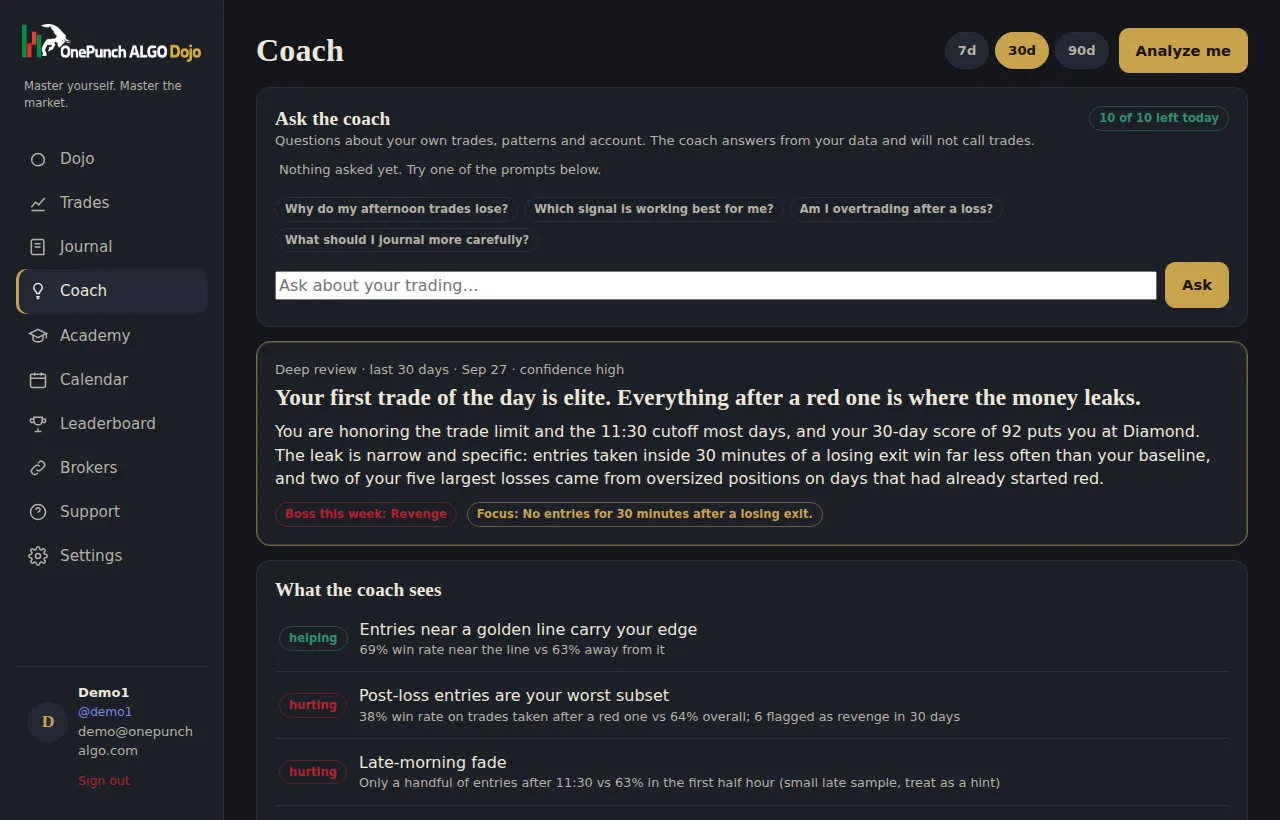
You sign a rule contract: max trades a day, a cutoff time, a size limit, a wait after a loss. Every session is graded against it from 0 to 100. Belts move on process, from Recruit to Grandmaster. Nobody earns a belt by getting lucky.
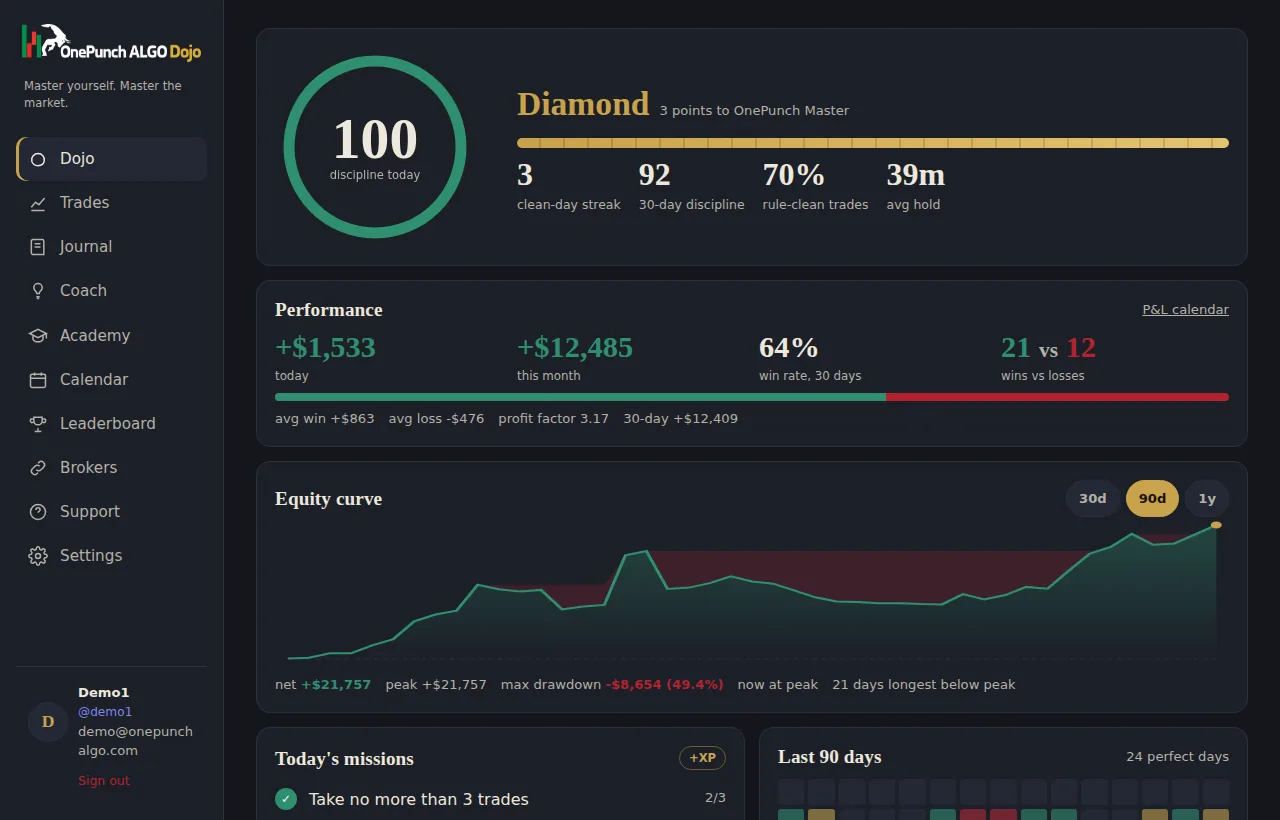
A behavioural review of your last 7, 30 or 90 days: what is working, what is hurting, the one rule to focus on, with the numbers that prove it. Then ask it up to ten questions a day about your own trading. It answers from your data and never calls trades.
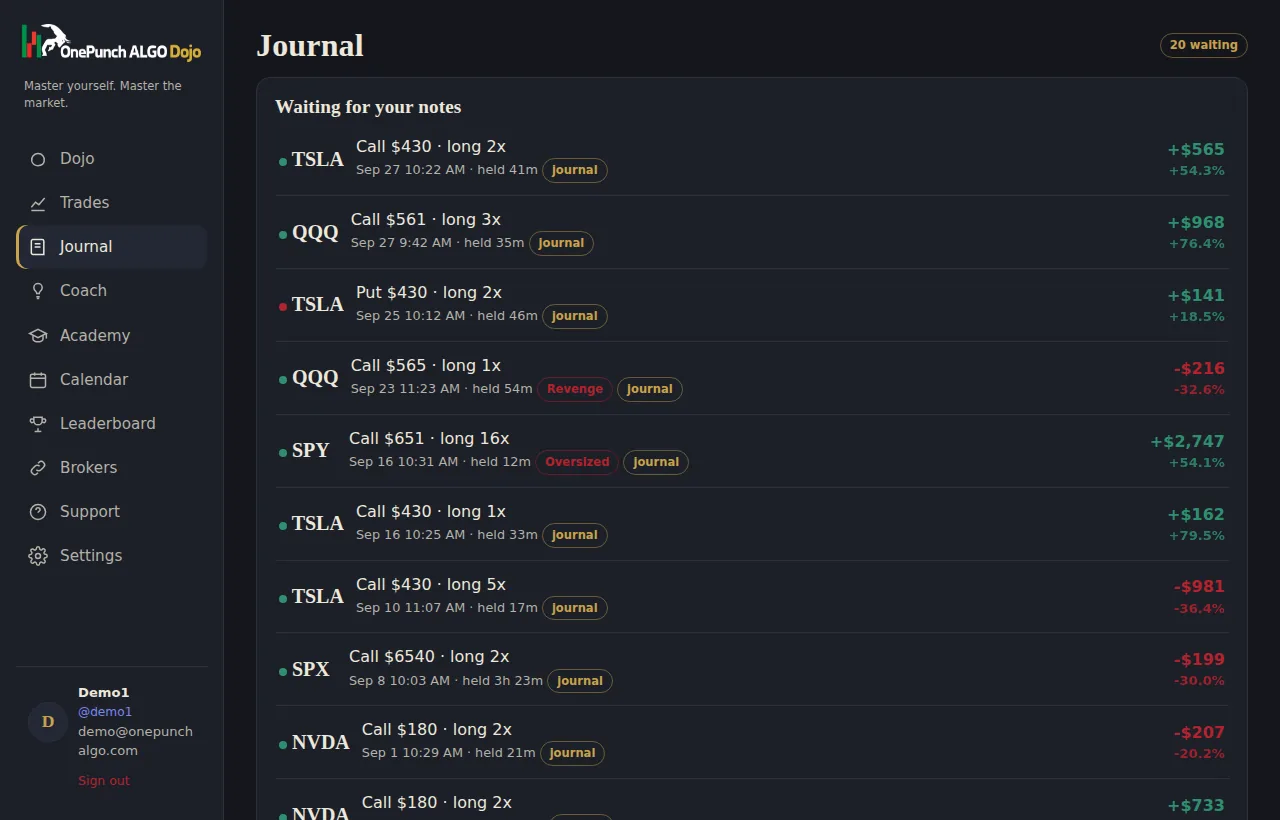
Tag each trade with the indicator that fired, the signal you took, whether the entry was near a golden line, the stochastic reading, the MACD-SMA state, your emotion and a setup grade. Paste up to three screenshots. Five minutes a day.
Tradervue is a well established web journal. It supports many brokers and asset classes, offers detailed reports, and lets traders share annotated trades. For someone trading stocks, futures and options across several accounts who wants a broad reporting tool, it is a reasonable choice.
People usually look for a Tradervue alternative when their needs are narrower and deeper: they trade options, often same-day contracts, and what they want most is help with discipline and execution rather than more reports. That is the gap the Dojo is designed for.
The clearest way to frame Tradervue vs the Dojo is breadth versus focus. A general journal measures results across many markets. The Dojo measures behaviour for option traders: a rule contract you write, a daily discipline score, a locked daily plan with an adherence score, and belts that move only on process. It is built to change how you trade tomorrow, not only to describe what happened yesterday.
Everything is measured the way option traders think: percent return on premium, hold time in minutes, calls and puts, and results by trading wave. Every position is enriched automatically with market context from the underlying chart, including VWAP distance and bands, SMAs, stochastic and MACD, and whether the entry came on a close through a level or a retest. You add only the indicator, signal and a few quick labels.
The AI coach then answers questions about your own numbers, such as whether your retests outperform early entries or how you trade on CPI mornings, with the trade counts shown and every figure checked against your data.
The Dojo syncs Robinhood, Webull, Webull Canada, Schwab, tastytrade, E*Trade and Fidelity through a read-only connection, with Interactive Brokers coming soon and CSV import for others. A nightly sync brings each session in, Sync now pulls it in after the close, and Quick log records a trade the moment you exit.
The daily loop is short: write the plan before the open, trade, then spend five minutes tagging positions after the close. The weekly recap email and the calendar with economic releases close the loop.
Most people who try a Tradervue alternative keep their old tool for a month while the new one proves itself. With the Dojo that is easy: connect your broker read-only, import older trades by CSV if you want them, and let the automatic market context run across your history in the background. Within a day you can ask the coach real questions about your own entries.
The first week is about habits rather than reports. Write a plan before each open, tag positions after the close, and watch the discipline score. By the end of the month you will know whether a focused journal for options traders changes your results more than a broader reporting tool, which is the only comparison that really matters.
If you trade stocks or futures as well, you may decide to keep both: a broad journal for the whole portfolio and the Dojo for the option trades where discipline and timing decide the outcome.
Choose Tradervue if you trade several asset classes and want the broadest reporting and sharing features. Choose the Dojo if you trade options, especially with the OnePunch method, and want a system that scores discipline, records market context without manual work, and coaches your behaviour with your own data. At $19 a month with every feature included, the Dojo is also a simple Tradervue alternative to try for a month alongside what you use today.
Both journals are good tools. This table is about fit, not about winning an argument. Tradervue pricing as published on its site and subject to change.
| OnePunch Dojo | Tradervue | |
|---|---|---|
| Broker sync (Robinhood, Webull, Schwab, tastytrade, E*Trade, Fidelity; IBKR soon) | Yes, read-only, nightly | Import files or sync on higher plans |
| Built for 0DTE options | Yes | General purpose |
| Discipline score against your own rules | Yes | No |
| AI coach with questions | Yes, ten a day | No |
| OnePunch method journal fields | Yes | Generic tags |
| Community leaderboard by percent | Yes, opt in | No |
| Method certifications | Yes | No |
| Charts with entry and exit | Yes, your own free data key | Yes |
| Price | $19 a month | $29.95 to $49.95 a month |
Choose Tradervue if you trade many asset classes and want the deepest statistics library. Choose the Dojo if you trade options with the OnePunch method and want a system that grades your discipline and coaches your behaviour.
$19 a month. Sync your broker tonight, meet your coach tomorrow morning.
Subscribe for $19/month See the live demo